
A MAF sensor can be tested without a scan tool. How? With a digital multimeter. Yes, a digital multimeter can be used in testing the mass air flow (MAF) sensor.
In this article, I am going to briefly explain the three basic multimeter tests that are done to find out if it's bad or not. Although I'm not going to be going into details about each of the different type types of MAF sensors, I'll show you where you can find tutorials to test the MAF sensor for Buick, Chevrolet, Ford, GMC, Isuzu, Mazda, Mercury, Nissan, Oldsmobile, and Volkswagen (on last page of article).
Contents of this tutorial:
 You can find this tutorial in Spanish here: Cómo Se Prueba Un Sensor MAF -Soluciones Automotrices (at: autotecnico-online.com).
Symptoms Of A Bad MAF Sensor
The most common symptoms of a bad MAF sensor are:
- A MAF sensor code.
- Lean and/or rich code(s).
- Fuel trim code(s).
- A tremendous lack of power upon acceleration.
- Black smoke coming from the tail-pipe.
- Vehicle may idle rough and stall.
As stated before, the mass air flow test is a very easy and simple test but there are a couple of things that have to be done first.
Is The MAF Sensor Dirty?
The most important thing to do first, is to make sure your MAF sensor isn't contaminated with dirt and/or oil, since the tests in this article assume the MAF sensor isn't contaminated. Why? Because this MAF sensor is a hot-wire type that easily becomes contaminated with dirt and stuff from the air filter not performing its job. Cleaning this type of sensor is easy since the hot-wires are clearly visible to the eye (with the sensor removed).
This contamination will cause the sensor to produce a lower reading to the fuel injection computer. The most common symptom of this contamination is a hesitation or a time-lag in engine response that is felt after the accelerator pedal is depressed. As stated in the list at the beginning of this article, other symptoms may include but are not limited to: higher tailpipe emissions and diagnostic codes that may illuminate the check engine light.
If cleaning the MAF sensor, use an electronics spray cleaner to do it with. This in itself may solve your problem. Don't use carb or brake clean spray. These solvents can damage the sensor. Also, don't attempt to physically clean the sensor with anything. Check your local auto parts store, they will have MAF sensor cleaning spray.
After having checked for contamination the other things that you must check for (and eliminate if present) are:
- That the engine does not have any vacuum leaks.
- That there are no ignition system misfires. A misfire condition will skew the results of the test you'll perform here.
If the above conditions exist, repairing them first will more than likely solve your vehicle's drive-ability issue without having to test the MAF sensor, if not continue with the MAF Test in this article.
How Does The MAF Sensor Work?
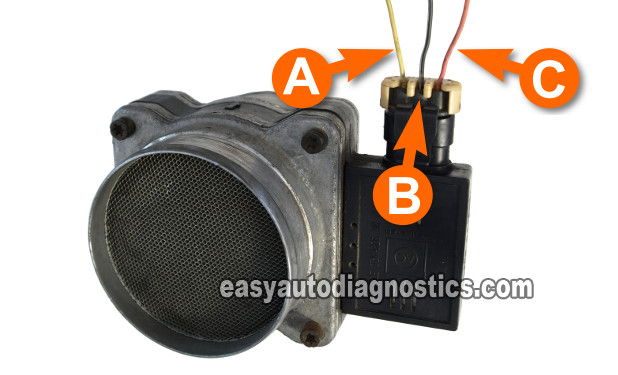
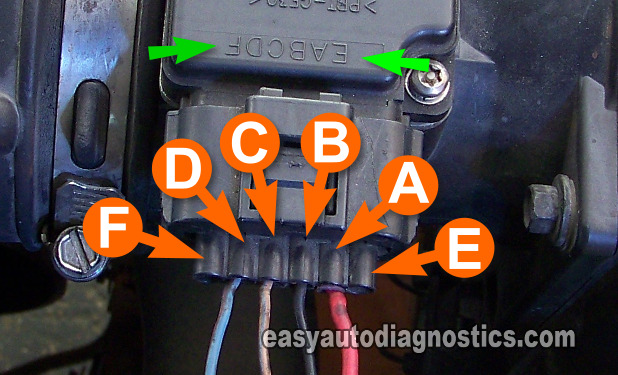
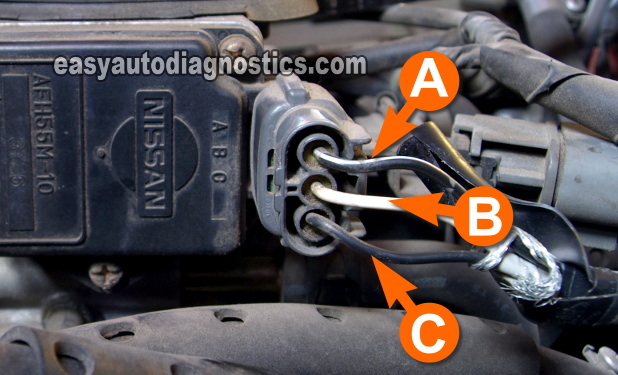
To be able to understand how to test a MAF sensor, it's always good to know how it works.
The most important thing that you need to know is that the MAF sensor signal is directly related to the amount of air the engine is breathing when it's running.
This tells us that the engine will breathe in more air at 2500 RPM than when it's idling at 900 RPM. Taking this into account, the output value (Volts or Hz) that the mass airflow sensor will generate, and that you can verify with a multimeter, will be greater at 2500 RPM than at 900 RPM.
Another very important thing to know, when testing a mass air flow sensor, is that we don't need to know the exact voltage value for certain engine RPM. What is important is that the MAF sensor signal should increase when you accelerate the engine and should decrease once you let the engine return to idle.
I can tell you, from personal experience, that in nine out of 10 cases when the mass airflow sensor fails, it simply stays stuck producing one specific voltage (or Hz) value no matter how much you accelerate the engine.
Testing The MAF Sensor With A Multimeter
Although MAF sensors will vary in their setup from one car to another, generally there are 3 basic test that are done to see if it has failed or not. These three tests are:
- Making sure the MAF sensor is getting power. Power is in the form of 10 to 12 Volts DC.
- Making sure that the sensor is getting Ground.
- Making sure that the MAF sensor is generating a signal that increases/decreases when the engine is revved up/returned to idle.
What complicates testing a MAF sensor is the fact that it could have 3, or 4, or 5 wires coming out of its connector. This requires using a wiring diagram (of the fuel system management system) to be able to know which wire is the one that feeds 12 Volts, which one is the that feeds Ground, and which one is the one that carries the MAF signal to the fuel injection computer.
Making sure the MAF sensor is getting 10 to 12 Volts: Generally, the mass airflow sensor get 12 Volts when the key is in the on position. These 12 Volts usually come from a fuse or a relay.
If the mass airflow sensor is being fed with 10 to 12 Volts, then the next step is to make sure it's getting around.
Making sure the MAF sensor is getting Ground: Depending on the make and model of your car, the mass airflow sensor will get Ground from the engine/chassis or through the fuel injection computer.
The only way to find out where the Ground is coming from is consulting a wiring diagram of the engine management system.
If the MAF sensor is getting Ground, then the next step is to make sure that it's generating a MAF signal.
Testing for the MAF signal: If the mass airflow sensor is getting power and Ground, then the next step is to make sure it's generating a correct signal. This signal will either be and analog signal or a digital signal.
If the mass airflow sensor is designed to generate an analog signal, then this signal will be a Volts DC signal and you'll be able to use your multimeter in its Volts DC mode to see it.
If the mass airflow sensor is designed to generate a digital signal, then it'll be a Hertz (Hz) frequency signal and you'll need to use a multimeter that reads Hertz frequency.
The MAF signal has to be verified with the sensor connected to its electrical connector and with the engine running. This means that you'll need to use either a back probe or a wire piercing probe to access the signal within the wire.
Mass Air Flow Sensor Test Tutorials
Here are all the links to the mass airflow sensor tests that you'll find in this a website and at troubleshootmyvehicle. Com.
Here are the Ford MAF sensor tests:
- MAF Sensor TEST 2.0L Escort, Tracer (1997-2002).
- How To Test The Ford Mass Air Flow (MAF) Sensor.
- How To Test The Ford MAF Sensor (4.2L, 4.6L, 5.4L).
Here are the GM MAF sensor tests:
- How To Test The MAF Sensor GM 3.1L, 3.3L, 3.8L (1989-1996).
- How To Test The MAF Sensor: P0100, P0101, P0102, P0103.
- How To Test The Mass Air Flow (MAF) Sensor (GM 3.5L).
- How To Test The MAF Sensor (GM 3.8L V6 1996-2005).
- How To Test The GM MAF Sensor (3.1L, 3.4L, 4.3L, 5.0L and 5.7L).
Here are the Isuzu MAF sensor tests:
Here are the Mitsubishi MAF sensor tests:
- MAF Sensor Test (2.4L, 3.0L Mitsubishi 1999-2004).
- How To Test The MAF Sensor (1997, 1998 3.0L Mitsubishi Montero).
Here are the Nissan MAF sensor tests:
- Mass Air Flow (MAF) Sensor Test Nissan Sentra 1.6L (1995-1999).
- How To Test The 2000-2002 Nissan Sentra 1.8L MAF Sensor.
- Mass Air Flow (MAF) Sensor TEST 2.4L Nissan D21 Hard Body (1990-1995).
- Frontier, XTerra MAF Sensor Test P0100: Mass Air Flow (MAF) Circuit Malfunction.
- How To Test The Throttle Position Sensor (1990-1994 3.0L Pathfinder).
- Mass Air Flow (MAF) Sensor TEST 3.0L Nissan Quest (1993, 1994, 1995).
- Mass Air Flow (MAF) Sensor TEST 3.0L Nissan Maxima (1995-1999).
- Mass Air Flow (MAF) Sensor TEST 3.3L Frontier, Quest, Pathfinder, XTerra.
- Mass Air Flow (MAF) Sensor TEST 3.5L Nissan Pathfinder (2001-2003).
Here are the Suzuki MAF sensor tests:
- How To Test The MAF Sensor (2.5L Suzuki Verona).
- How To Test The MAF Sensor (2.5L Suzuki Grand Vitara).
Here are the Volkswagen MAF sensor tests:
- VW Mass Air Flow (MAF) Sensor Test (5 Wire Type).
- Testing The VW Passat (98-99) Mass Air Flow (MAF) Sensor.

If this info saved the day, buy me a beer!
