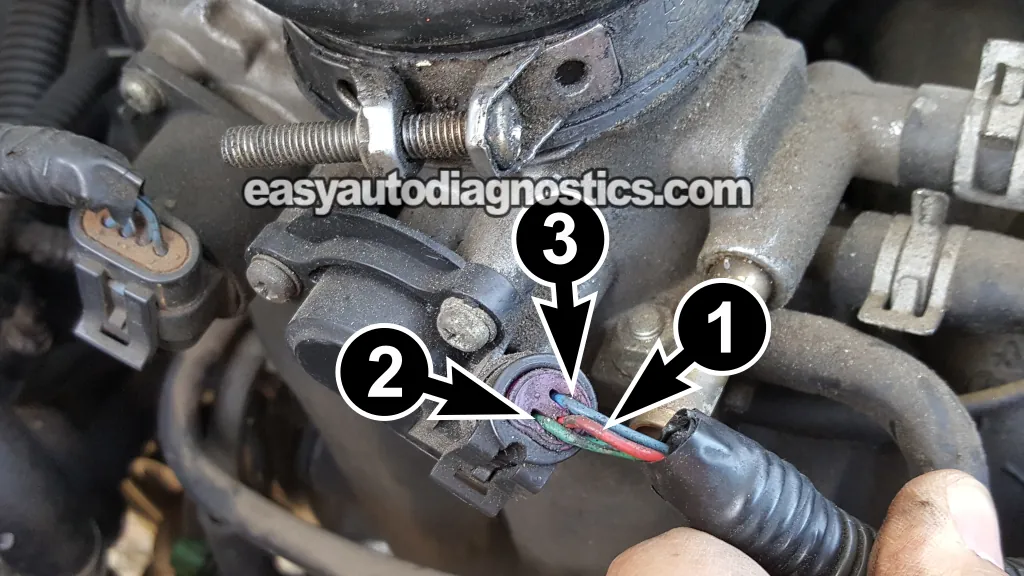
This tutorial will help you to test the throttle position sensor on the 1998-2003 2.2L Isuzu Rodeo and Amigo.
The TPS is a simple 3-wire component that can be easily tested with a multimeter. You don't need a scan tool (although having one is great).
In this tutorial, I'll explain how to test it in a step-by-step manner. You'll be able to easily find out if the TPS is bad or not.
Contents of this tutorial:
- Symptoms Of A Bad Throttle Position Sensor.
- Throttle Position Sensor (TPS) Circuit Descriptions.
- Where To Buy The TPS And Save.
- TEST 1: Testing The TPS Voltage Signal.
- TEST 2: Making Sure The TPS Has 5 Volts.
- TEST 3: Making Sure The TPS Has Ground.
- More 2.2L Isuzu Rodeo And Amigo Diagnostic Tutorials.
ES  You can find this tutorial in Spanish here: Cómo Probar El Sensor TPS Con Multímetro (1998-2003 2.2L Isuzu Rodeo, Amigo) (at: autotecnico-online.com).
NOTE: This tutorial applies to the following vehicles since they use the exact same throttle position sensor:
- 2.2L Isuzu Amigo: 1998, 1999, 2000.
- 2.2L Isuzu Rodeo: 1998, 1999, 2000, 2001, 2002, 2003.
Symptoms Of A Bad Throttle Position Sensor
The throttle position sensor has the job of measuring the amount the throttle plate opens as you step on or off the accelerator pedal.
To be a bit more specific, the throttle position sensor produces a voltage signal that increases as you step on the accelerator pedal and the throttle plate opens.
When you step off the accelerator pedal and the throttle plate starts to close, the TPS voltage signal decreases back to its original base voltage.
All of these changes of the throttle plate angle, are constantly reported to your Isuzu Rodeo's fuel injection computer.
Since the throttle position sensor (TPS) is such an important component of the fuel injection system of your 1998-2003 2.2L Isuzu Rodeo, when it fails, you're gonna' definitely feel the engine resent it.
You're going to see the following TPS diagnostic trouble code lighting up the check engine light:
- P0122 TPS Voltage Too Low.
- P0123 TPS Voltage Too High.
You're also going to see one or more of the following symptoms:
- Won't pass the state mandated emissions test.
- Bad gas mileage.
- Lack of power, rough idle, or hesitation.
- Engine cranks a long time before starting.
Throttle Position Sensor (TPS) Circuit Descriptions
Blah.
| Terminal | Wire | Description |
|---|---|---|
| 1 | RED | 5 Volts |
| 2 | Green (GRN) | Sensor Ground |
| 3 | Blue (BLU) | TPS Signal |
Where To Buy The TPS And Save
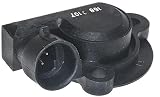
The 1998-2003 2.2L Isuzu Rodeo's TPS is a pretty inexpensive component. The following links will help you to comparison shop and hopefully save you a few bucks on its purchase:


Disclosure: As an Amazon Associate, I earn from qualifying purchases. Buying through these links helps support this site at no extra cost to you. Thanks for your support —it really means a lot!
NOTE: The above throttle position sensor (TPS) fits the following vehicles: 1998, 1999, 2000, 2001, 2002, 2003 2.2L Isuzu Rodeo And Amigo.
TEST 1: Testing The TPS Voltage Signal
The important thing to remember when testing the TPS, is that its voltage signal increases as the throttle plate opens and as it closes, the voltage decreases.
If the throttle position sensor is bad, it'll usually stay stay producing one voltage value as you open/close the throttle plate.
For our first test, we're gonna' connect the multimeter to the TPS signal wire and see if TPS voltage signal increases/decreases as we open/close the throttle plate.
The wire that we're gonna' connect the multimeter to is the blue (BLU) wire of the connector.
In the photo above, I've labeled the BLU wire with a number 3.
IMPORTANT: The throttle position sensor (TPS) must remain connected to its electrical connector for this test to function properly. To be able to access the voltage inside the signal wire, you'll need to use either a back probe or a wire piercing probe. You can see an example of this tool here: Goupchn 4mm Banana to Banana Plug Test Leads Kit (Amazon affiliate link).
Let's get started:
- 1
Turn the key to the ON position but don't crank or start the engine.
- 2
Place your multimeter in Volts DC mode.
- 3
Connect the red test lead to the BLU wire of the TP sensor harness connector.
- 4
Ground the black multimeter test lead directly on the battery negative (-) post.
- 5
Your multimeter should register between 0.4 to 0.9 Volts DC at this point.
- 6
Manually rotate the throttle.
You'll get the best results by opening and closing the throttle directly on the throttle body instead of stepping on the accelerator pedal. - 7
The multimeter should show an increasing voltage as you (or your helper) open up the throttle.
You'll get the best results by opening and closing the throttle directly on the throttle body instead of stepping on the accelerator pedal. - 8
The multimeter should show a decreasing voltage as you begin to close the throttle.
- 9
Using a screwdriver's handle, gently tap the TP sensor as you open and close the throttle and observe the multimeter.
The purpose (of tapping the TP sensor with the screwdriver's handle) is to see if the TP sensor shows gaps in the voltage signal. Why? Because a good TP sensor will show a continuous increasing or decreasing voltage signal even while getting tapped by the screw-driver's handle.
Let's analyze your test results:
CASE 1: The TPS voltage signal increased/decreased as you opened/closed the throttle plate. This is the correct test result and it confirms that the throttle position sensor is OK (not bad).
With this test result you can also conclude that the TPS sensor is getting both power (5 Volts) and Ground from the fuel injection computer.
CASE 2: The TPS voltage signal DID NOT increase/decrease as you opened and closed the throttle. This test result usually indicates that the TPS sensor is defective.
To make sure the TPS sensor is bad the next step is to check that the red wire is feeding the TPS with 5 Volts. For this test go to: TEST 2: Making Sure The TPS Has 5 Volts.
CASE 3: The multimeter DID NOT register any voltage. This test result usually indicates that the TPS sensor is defective.
To make sure the TPS sensor is bad the next step is to check that the red wire is feeding the TPS with 5 Volts. For this test go to: TEST 2: Making Sure The TPS Has 5 Volts.
TEST 2: Making Sure The TPS Has 5 Volts
The wire that feeds the throttle position sensor with 5 Volts is the red (RED) wire of the TPS connector.
To check for the presence of these 5 Volts in the RED wire, we'll do a simple multimeter voltage test.
These are the test steps:
- 1
Place your multimeter in Volts DC mode.
- 2
Disconnect the TPS from its electrical connector.
- 3
Turn the key the ON position but don't start the engine.
- 4
Connect the red multimeter test lead (using the appropriate tool) to the RED wire.
- 5
Connect the black multimeter test lead to the negative (-) battery terminal.
- 6
Your multimeter should read 4.5 to 5 Volts DC.
Let's analyze your test results:
CASE 1: The RED wire is feeding the TPS with 5 Volts. This is the correct test result.
Now that you have confirmed that your 2.2L Isuzu Rodeo's TPS is getting 5 Volts, the next step is to make sure it's getting Ground. Go to: TEST 3: Making Sure The TPS Has Ground.
CASE 2: The RED wire IS NOT feeding the TPS with 5 Volts. Without these 5 Volts the TPS, on your 2.2L Isuzu Rodeo, will not function.
The most likely cause of these missing 5 Volts is an open-circuit problem in the RED wire between the TPS sensor's connector and the fuel injection computer's connector.
TEST 3: Making Sure The TPS Has Ground
For our last throttle position sensor test, we're gonna' make sure that the green (GRN) wire is providing Ground.
We'll confirm the presence of Ground in the GRN wire by doing a multimeter voltage test.
NOTE: Ground is provided by the fuel injection computer of your 2.2L Isuzu Rodeo. Be careful and don't connect this wire to battery 12 Volts or you'll fry the fuel injection computer. The multimeter voltage test I'm suggesting below is a safe way to test for the presence of Ground in the wire.
Let's get started:
- 1
Place your multimeter in Volts DC mode.
- 2
Disconnect the TPS from its electrical connector.
- 3
Turn the key the ON position but don't start the engine.
- 4
Connect the black multimeter test lead (using the appropriate tool) to the GRN wire.
- 5
Connect the red multimeter test lead to the positive (+) battery terminal.
- 6
Your multimeter should read 10 to 12 Volts DC.
Let's analyze your test results:
CASE 1: The GRN wire is feeding Ground to the TPS. This is the correct test result.
You can correctly conclude that the TPS is defective if you have:
- Confirmed that the TPS voltage signal does not increase/decrease as you opened/closed the throttle plate (TEST 1).
- Confirmed that the TPS is getting 5 Volts on the RED wire (TEST 2).
- Confirmed that the TPS is getting Ground on the GRN wire (this test).
Check my TPS recommendations here: Where To Buy The TPS And Save.
CASE 2: The GRN wire IS NOT feeding Ground to the TPS. Without Ground the TPS will not function.
The most likely cause of this missing Ground is an open-circuit problem in the GRN wire between the throttle position sensor's connector and the fuel injection computer's connector.
More 2.2L Isuzu Rodeo And Amigo Diagnostic Tutorials
You can find a complete list of 2.2L Isuzu Rodeo and Amigo tutorials in this index:
Here's a small sample of the tutorials you'll find in the index:
- How To Test The Fuel Injectors (1998-2003 2.2L Isuzu Rodeo, Amigo).
- How To Test The Fuel Pump (1998-2003 2.2L Isuzu Rodeo, Amigo).
- How To Test Engine Compression (1998-2003 2.2L Isuzu Amigo And Rodeo).
- How To Test For A Blown Head Gasket (1998-2003 2.2L Isuzu Amigo And Rodeo).

If this info saved the day, buy me a beer!